Theory of Beam Gravitation
One of the undiscovered basic phenomena of the universe remains to be the nature of gravitation. As the investigations studying the narrow fields do not produce results, one may choose another method for the comprehension of this factor, i.e., comparison of the facts which have already been proved.
Beam
For the beginning let us appeal to such a sufficiently interesting question: Why are all the physical and chemical processes completely identical and are unimaginably stable in the whole universe? Which mighty mechanism ensures this stable synchronism in the course of billions of years from galaxical scales up to the sub-atomic level? Why do some electro-magnetic waves and radiation move with the same speed, though they are generated by completely different physical processes? Or such a question: why are all the celestial bodies of planetary size spherical in form?
What makes the photons of the light, radio-waves, electric power, neuron, laser beam and other waves and particles move with the same speed? Logically this question may be answered like this: Neither the particles, nor the waves do not move owing to the force of the initial outburst. But there is a universal “conveyer”, which carries all these particles. That is, different types of particles and waves are only ‘the passengers” of this transport system. Various physical processes generate different types of particles and waves, and they catch up these rushing conveyers, and therefore they move with the same speed – the speed of the movement of the conveyer. The waves created by them have an impact on the features of this conveyer system. For instance, the beam of the light spreads all around and from all the sides on a straight line. It means that the conveyer system may also be regarded as a system consisting of straight lines with the speed of light. The strained threads of this light fill the whole universe. As the topic of this research is gravitation, we shall call these beams the gravitation beams and the research – Theory of beam gravity (TBG).
The relation of the spread of electro-magnetic waves to gravitation beams allows answer to one of the basic questions of the universe: why does not the speed of the light depend on the speed of the movement of the source of light? The answer has been given above, but let us tries to reply to it by using a simple example: let us think that the hat of the passenger on board of the boat, which sails against the current of the river, drops into water. Just at this moment a leaf from the tree on the bank of the river falls into the river. Though the boat speeds forward against the stream, and the tree stays on the bank, the hat and the leaf sail with the speed of the current of the river. Exactly in the same manner move forward the light and other electro-magnetic waves with the speed of the waves, and their speed does not depend on the speed of the source.
Now let us have a look at the linearity and stability of the speed of the light. In the course of billions of years photons fly to the earth from the most distant stars straightly and with the same speed. Let us think that they get their initial speed from the source which pushes them forward with the speed of light. If it is like that, then some questions remain unanswered. Question 1: How does it happen that the powerful sun and the weak candle eject the photons with the same speed? Question 2: If the photon moves forward the initially obtained kinetic energy of the outburst, then why does it not lose a part of that energy and speed when it falls on a mirror, even on tens of mirrors in turn like a tennis-ball, which loses a part of its initial energy and speed, when it encounters a wall on its way? The assumption with the beam provides a comprehensive answer to this question. If the photons convey the beams, then there is no difference whether these particles are generated by the powerful sun or the weak candle. But when the photons touch the surface of the mirror, the latter does not return them. They are conveyed to the beams in the reflection spot, which move in the reverse direction. The conveying and receiving beams move with the same speed. Therefore the speed of the photon does not slow. It is known that not only the surface of the mirror reflects the light, the surface of other objects as well, which we see. We see the objects, all their subtleties owing to the beams returning backwards, which penetrate into the matter of the object seen by us and convey it to the retina of our eyes the reflected photons separately, not violating the spatial order.
If to assume that the photons convey the beams, and these beams may convey photons to other beams, the effect of gravitation lensing discloses certain properties of these beams. This effect shows that there is a considerable interaction between the beams and the matter. Let us have a look at the scheme below:

Let us suppose that beams C convey to us photons from distant stars, they interact with two perpendicularly opposite beams, B on the left, A on the right. There where there is not a big celestial body, the beams A and B have the same power. Their impact on the photons completely compensate each other, the photons retain rectilinear movement. But it is quite different when there is a big celestial body nearby. Let us suppose that this celestial body is the sun and it is on the left. The beams which come from the left pass through the sun. While passing through the huge body the beams B are partially absorbed and weaken. As a result, the photons are influenced not by two equally powerful beams, because the beams B are weaker than the beams A, as a result of their total impact the photons incline towards the sun.
Gravitation – the fight of the opposite beams
The relation of the above-mentioned beams with the effect of gravitation lensing gives an important key for understanding the essence of gravitation. The body influences the beams and absorbs a part of them, and the beams exert influence on the body in proportion with the amount of absorption. Let us have a look at it on a simplified scheme.

Let us suppose that the big circle is the earth, the smaller one – some body which is under the gravitation attraction of the earth. Two types of beams exert an impact on the body, the beams B and A. The beams A1 being the continuation of the beams A pass through the whole body of the earth, are partially absorbed and weaken. But the beams B do not pass through the planet and do not weaken. As a result, the beams A become stronger than the beams B. It is clear that the bigger the celestial body is, the more beams they absorb and stronger becomes the difference between the beams A and B. This explains the dependence of the power of attraction from the mass of interacting bodies. Such an approach explains the dependence of the force of attraction on the mass of celestial bodies directly.
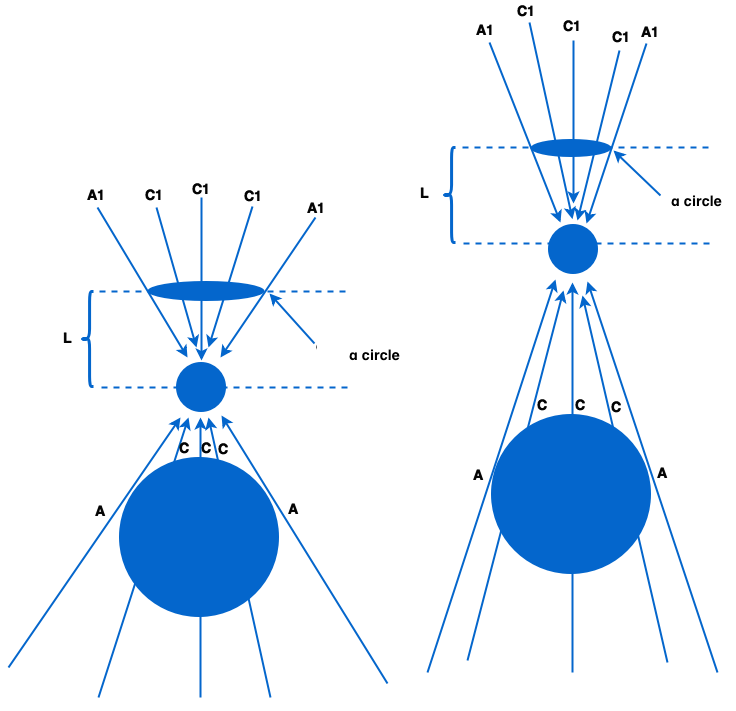
It is seen from the scheme that the beams A pass close to the big body. The beams C pass through the thickness of the body. Besides the beams A, the beams A1, which are opposite to those beams, exert influence on the small body. Beams A and A1 are equal in force, and their actions completely compensate each other and they do not take part in the birth of the gravitation force. Quite differently behave the beams C and C1. The beams C pass through the thickness of the big body, are absorbed and weaken. As a result, the repulsing force of C beams grows weaker than the pressing power of C1 beams and the gravitation force appears. It is seen from the scheme that when the bodies are close to each other spatially the number of C beans and C1 beams, which counteract against them become rather more than when they stand far from each other. The more number of beams C and C1 counteract against each other, the more becomes the difference between the repulsing and pressing powers of these beams, and the more becomes the gravitation power. If it is expressed in round numbers, it will be like the following:
Fg = (С 1-С)n
Here Fg is the power of gravitation, n the number of beams. The number of beams are not known to us. But we know that light and other electro-magnetic waves everywhere and in all the directions are spread equally. It means that in all the parts of the space the density of the beams is the same. Therefore the space of the circle a, through which the beams pass the beams C and C1, may be chosen for counting the number of these beams. The circle a is at a distance of L from the center of the small body. We must note that any change in the distance between the bodies do not affect L, it remains unchanged. For simplicity of expression L may be taken as equal to the radius of the earth. In such conditions with the changes in the distance between the bodies the space of the circle will change as well. The change in the space of the circle strikingly coincides with the change of gravitation force. It is known that with the increase of the distance between the bodies the force of gravitation decreases equal to the size a square of that increase. The same happens with the space of the circle a. A sufficiently simple calculation shows that in the case of such an increase of distance the space of circle a decreases equal to the square of this increase. For instance, if the distance between the bodies increases twice, the power of gravitation and the space of circle adecreases four times. If the distance R increases 5,3 times, the power of gravitation and the spce of circle a decreases for 28,09 times, etc. Let us do such a calculation, and suppose that a body is at 2R distance from the center of the earth, i.e., at a distance of 12742 km. It is clear that if the body departs from the earth 2,75 times, the power of gravitation decreases for 7, 56 times. It means that when the distance increases for 2,75 times, the space of Circle a decreases for 7, 56 times. Let us calculate with the help of the scheme below:

There are two triangles on the scheme. Side B in the bigger triangle is equal to the radius of the earth. Side A is the distance between the center of the earth and the attracted body, and it is equal to 2R. In this case the length of hypotenuse and sinus of the sharp angles will be like the following:
C = √(6371^2+12742^2) = 14245
sin α = A/C = 0.8944; sin β = B/C = 0.4472
As it was noted above, Side A1 of the smaller triangle is the distance between the smaller body from the center to Circle a and it is equal to R. Let us find out the length of B1:
B1 = (A1 / sin α) * sin β = (6371/0.8944) * 0.4472 = 3185
Cathetus В1 of the small triangle is the radius of Circle a. It means that the space of the said circle is equal to:
S = 3.14 * (3185^2) = 31852866
If the distance between the body and the earth (cathetus of A of the bigger triangle) increases 2, 75 time, the power of gravitation and the square of Circle a decrease for 7, 56 times. The said can be proved with the calculation below. After increasing the length of Cathetus A, the length of the side of the newly-formed three-angle will be like the following:
A” = 2R * 2, 75 = 35040, 5
Now let us carry out the calculations with new data:
C” = 35615; sinα = 0.9839; sinβ = 0.1789; B1” = 1158
In this case the space of the newly-emerged Circle a will be equal to:
S” = 3,14 * (1158^2) = 4210626
Now let us compare the spaces of the circles α and α”
S/S”= 31852866/4210626 = 7.56
The calculations unequivocally show that when the distance between the body and the earth and the gravitation power increases, the space of Circle a decreases 7, 56 times. It is commonly known that the gravitation attraction has been directed strictly to the center of the earth. It is explained by such a fact that the vector sum of all C and C1 beams all the time is directed to the center.
Neutrino Contribution
Now let us try to understand what the word combinations “partial absorption and attenuation of beams” mean. It may be a qualitative change, for instance, reduction of the speed of beams while passing through the body, a quantitative change, when the number (or some other parameters) of the penetrating beams decreases. For its explanation let us look at the following experiments connected with neutrino:
1) Sensational results of the European researchers in which neutrino surpasses the speed of light.
2) The experiment called “the Poltergeist Project”. The result is: a small part of the huge number of neutrino, which passes through the matter, clash with the nuclear of atoms. Neutrino is absorbed and turns the atoms of chlorine into the atoms of argon.
3) The experiments of Super Komiokande. It revealed that when the stream of neutrino passes through the thickness of the planet, not all “the spectral particles” reach the opposite surface of the earth. According to the results of the experiment almost half of the particles registered on one side of the surface of the earth are absorbed by the matter of the planet, only half of them reach the other surface on the opposite side of the terrestrial globe.
If all these facts are reviewed together we shall have the following results. Neutrino move with the speed of light. It means that they are also transported by gravitation beams. If neutrino does not slow its speed while moving through the thickness of the matter, but even “outrun” the photons, then the conclusion is like this: the speed of neutrino in the entrails of the matter, and, consequently, the beams, which convey them, does not decrease. Those neutrinos which reach the nuclear are absorbed. But how do the beams, which reach the nuclear, behave? Logically either they are broken, or their power, intensity or any parameter must strongly weaken. And finally, Super Komiokande showed that while passing through the planet the number of neutrino decreases essentially. Therefore an important part of neutrino, which passes through the thickness of the earth, is absorbed by the matter of the earth. The comparison of the Poltergeist Project and the experiment of Super Komiokande show that the more matter is on the road of neutrino, the more number of them is absorbed. We may continue this idea and confirm that the more is the mass of the matter, the more nuclear material is on the road of beams, the more number of beams is absorbed. It gives rise to the interrelation between the mass of matter and the force of gravitation.
The above-said is confirmed by one sounder phenomenon: – the properties of the black hole. The black holes consist of the nuclear of atoms, or nuclear material. There are no inter-nuclear spaces in the matter of the black hole. If all the beams reach the nuclear, the number of the absorbed, broken and not reached to the opposite surface of the black hole becomes maximal in number. As a result, the difference between the repulsing and pressing forces of beams increases up to the limit, and their force of gravitation reaches the maximal. If all the beams broke and are not able to leave the black hole, consequently, the particles and waves, which the beams carry, are also unable to leave the black hole. If there is no beam, there is no information.
The notion of gravitation beams differently explains the case when two metal plates draw each other in the experiment of Kazimir. Let us have look at it in the picture below.

The beams A and C exert pressure on the external parts of the plates facing each other. They are equal in power. Passing through the plates both types of beams partially weaken. It becomes evident that A beams are stronger than A1 beams which are their continuation, and C beams are a little stronger than C1 beams. As a result the drawing power of A and C beams become a little stronger than A1 and C1 beams. The mass of the plates is not big for the birth of a perceptible gravitation. Therefore the pates draw each other very slowly.
In the frames of the Beam Shift Theory the Kazimir experiment gives a queue to one of the important questions of the universe: how do the stars emerge? If taken by cosmic measures the beams are able to draw to each other the metal plates within a very short time, then why should they not collect into a heap the much denser “clots” of galaxical gas? With the increase of the mass the gravitation around the new gas clot increases and a much more accumulation of the mass takes place. With the increase of the mass the difference of repulsing and pressing forces on the surface layer of “the future star” increases for many times. Let us have a look at it on the scheme below:
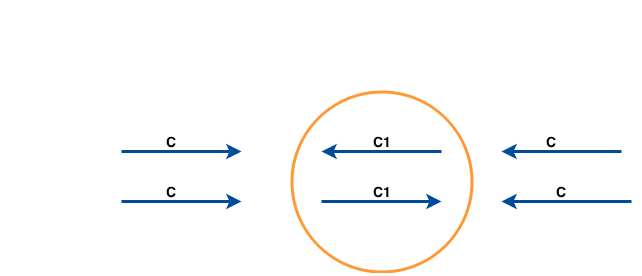
Let us think that the circle drawn here is gas mass. Equally powerful beams C exert influence on this mass from all the sides. Passing through the matter beams C are partially absorbed and their continuation, which are beams C1, reach the surface of the opposite layer in the weakened form. The difference between the strained beams C and repulsive beams C1 close to the surface layers of gas mass increases the growth of the gas formation. Because of a great difference in the two forces there emerges a huge strained power directed to the center of the gass mass. Under the press of the layers above the pressure and temperature in the center increases. When the critical mass is achieved, the thermonuclear reaction and gas mass turn into the star.
Beams as the builders atom nuclear
Owing to the pressure from all the sides huge masses of matter make a heap and create the planets and stars. The nuclear of the atom consists from protons and neutrons. It is known that the mono-charge particles repulse each other. What force is able to gather the positively-charged protons into one center? A key to it may be how the nutrino behaves in the matter. In the matter they move with the speed of the light almost without anything obstacling them. But a part of them, which fall into the nucleus, are absorbed. And those beams, which carried the the absorbing nutrino, also rest against the nucleus. They rest against the nucleus and naturally press the nucleus. If the beams resting against the nucleus weaken very much, or are copletely broken, it means that the counteraction of beams and nucleus is very strong. The nucleus consists of many elementary particles. Let us imagine that a separately standing proton surrounded by gravitation beams. Because of a strong absorptuon of beams the straining force around the nucleus will be maximal, but the repulsing force will be minimal. Now let us imagine a neutron not far from that proton subjected to the pressure of the same forces. It can be described in the scheme below like this:

Beams A and B rest against on the protons from the sides, they are absorbed strongly, and the continuation of these beams A1 and B1 weaken very much. Consequently, the pressing force of beams A and B will be much stronger than that of the repulsing force of the beams A1 and B1. The pressing force of beams is able to press not only the proton and neutron, but also the heap of protons and neutrons despite the electro-statistic repulsion of protons.
Dark matter or effect of gravitation summing
According to the contemporary researches the anomalous movement of the stars in the disk of spiral galaxy is possible owing to the presence of the dark matter. Law of World Gravitation (LWG) explains this anomaly without including the notion of the dark matter. According to the Law of World Gravitation, depending on the distance of stars from the center of galaxy their orbital speed must decrease. But in reality it does not take place. If with the increase of distance the speed does not decrease, and the structure of the galaxy does not collapse, then there is such a logical inference: proportional lengthening of the distance increases the gravitation, too. Let us have a look at it on the scheme below:

Let us assume that the big circle in the scheme is the dark hole, the smaller ones are the stars. The object of our research is the star Z If there had not been other stars between the Star Z and the center of galaxy, then the gravitation force of stars to the center would have been determined only with the difference between the stars B1 and D. In such a case the factor of distance would have acted in full conformity with the Law of World Gravitation. But between the star Z and the center of galaxy there are tens and hundreds of millions of stars. On the scheme we see that stars A, which pass through the matter, are very great in number, weaken greatly. The more is the stars (and inter-star gas, dust, etc.) on the road, much weaker grow the beams. Continuations of these beams, which reach the stars Z, are beams A1. As there is a great number of stars between the star Z and the center of galaxy, a considerable number of A beams pass in succession through a great number of stars (one and the same beam through many stars), and weaken much more. This successive absorption and reduction of gravitation beams form a physical phenomenon, which may be called the effect of gravitation summing. One may proceed from the above-said that Beam Z is subjected to the interaction of an additional force directed to the center of galaxy. This force emerges as a result of vector summing of the beams A1 and C.
Gravitation created by the beams B1 and D may conditionally be called the gravitation of the black hole. Let us conditionally call the gravitation created by the beams A1 repulsing from the center and by the beams C pressing towards the center gravitation of stars. With the increase of the distance from the center the gravitation of the black hole weakens. On the contrary, the star gravitation increases. As the beams A penetrate through a great number of stars when the distance increases, they weaken and the difference between the beams A1 and C grows. As a result, the distance increases the reduction of gravitation of the black hole, which is compensated by the increase the star gravitation. That is, the total power of gravitation does not weaken depending on the distance from the center, and the star Z continues its movement not slowing the orbital speed. Such “anomalous” movement is possible only in spiral galaxies, because, in such galaxies the majority of stars are in the galaxy disk on the same plane, where there is an ideal condition for the birth of a very great star gravitation.
All the stars in the disk move on an intricate trajectory. Because of this number of stars, through which beams A pass, change all the time. Therefore the final power of stars also changes all the time. And this in its turn affects the trajectories of movement of stars Z and all other stars subjected to star gravitation. Their trajectories will not be smoothly circular or smoothly elliptical, for instance, as the movement of planets around the sun. These trajectories will be spiral, in the form of a zigzag, etc. Our sun around the center of galaxy moves on a spiral trajectory.
Proceeding from the universal laws of physics, the effect of gravitation summing must be observed in smaller scales as well. For instance, in the times of the solar eclipse some gravitation on the earth is observed.
A very strong star gravitation takes place only in the disc of galaxy. It means that the force of gravitation will be a little more than in the halo of galaxy. There are concrete physical phenomena which show that the force of gravitation in the disc is higher than in the halo. These phenomena are the followings:
1). In the chemical content of many stars in the halo and disc there are considerable changes. There are tens of heavy bodies in the halo of stars, sometimes even hundred times less than in the stars of the disc. It is known that for the formation of much heavier elements there must be high temperature and pressure, that is, much stronger compression of the matter of stars. The mechanism of the birth of much more compression in the disc may be explained like this: Effect of gravitation summing leads to much stronger compression of stars to the center of galaxy. On the other hand, the orbital speed, and, consequently, the centrifugal force, which influences the stars, is very high. As a result, the stars revolving with a great speed in the disc are strongly compressed in the vices of two huge forces – high gravitation and huge centrifugal force. We may call such a mechanism, which increases the compression, a disc press
2) Brightness of stars in galaxy discs is considerably higher, than the brightness of stars out of the galaxy disc. Brightness of the star is the indicator of intensity of the thermonuclear reaction in the entrails of stars. In its turn the intensity of reaction is directly connected with pressure and temperature. Logically, namely the disc press is the cause why the degree of compression is a little higher in the stars of the disc than in the stars out of the disc.
3) Tally-Fisher Law. This law says that there is a direct dependence between the brightness of spiral galaxy, on the one hand, and on the mass of the orbital speed and size of the galaxy disc, on the other hand. Stars in great number crate much stronger effect of gravitation summing. That is, the bigger the mass of gravity, the stronger is the gravitation attraction, and in such conditions the structure of galaxy might be preserved under high speed of revolution of the disc. All this leads to the birth of a very strong disc pressure. And the more is the force of the press, the brighter is the star.
4) Much greater and much denser masses of intergalaxy gas are accumulated in the disk. Had there not been a force to keep them in the disc, dispression would have dispersed in the whole halo. The process of the formation of stars and supernew explosions also take place mainly in the discs. Logically, the above-mentioned processes are possible in the spaces where there is a sufficiently strong disk press compression. 5) The phenomenon of running stars. To explain the reason of the birth of this phenomenon let us imagine a pair of stars in the galaxy disc, and they revolve with a great speed around the center of gravity of the same pair system. After some time one of the pairs turns into a super-new star and explodes. After the explosion the center of gravity disappears in that pair system and the survived star X gets a huge speed. Let us suppose that this new movement has been directed in such a manner that an accute angle has emerged between the vector of this movement and the vector of the movement of the galaxical disk. The speed of of this movement is higher the velocity of revolution of the disk. As the star X moved in the general mass of the disc with the speed of the very disc before the explosion of the pair star, and after the explosion it has obtained a new additional speed in relation to the disc. With such a direction of superspeed movement the star X leaves the boundaries of the galaxical disc after some time and enters the halo. There emerges such a situation. The speed of the star X is much higher than the speed of the revolution of the disc, and the gravitation attraction in the halo is weaker and slower than in the galaxy disc. There is a huge speed and weak gravitation. Correspondence of these two factors leads to such a case that the star X leaves the center of galaxy with a great speed.
It is necessary to stress such a detail not of less importance. The running stars move with a great speed. It means that when they are within the boundaries of the disc, they will be subjected to high compression on the part of disc press. And they will be much brighter and much lighter.
6) Gravitation lensing is observed near such huge objects like spiral galaxies, their indicators are stronger for several times which they are to be theoretically The presence of much stronger lensing is conditioned by such a factor that along the imagined plane there is a strong gravitation. It means that in the plane of the disc, even beyond its boundaries, gravitation will be stronger than in the halo. When the light beams and this plane intersect a strong effect of lensing will be observed. Because of it, the form and number of the effect of lensing will depend on the angle between the line of our observation and the plane of the disc. If the line of our observation and the galaxical disc are on the same plane, then we see one or two effects of lensing of one object. If the line of observation and the disc are on perpendicular planes, then we see up to four, sometimes even more effects of lensing up to the birth of the Einstenian ring. But if the line of observation and the plane of the disc are located under an acute angle, then it is possible to observe such a form of lensing, which the astronomers call “a cosmic smile”.
Absolute stationary system
The observations of thousands of years show that the general picture of the starry sky has remained unchanged in the course of a long time. We observe distinct and stable picture of the distant galaxies, quasars and super-new stars. For instance, the cosmic satellites register distinct pictures of very distant quasars. It is possible only if trillions of photons, which leaves the surface of the quasar at the same time, reach the objective of the photo-camera at a twinkle. Pay attention, two not interconnected photons left the quasar at the same moment, in the course of tens of billions of years moved in the space with a huge speed and at a twinkle simultaneously reached the objective of the camera. Such an unimaginable simultaneity is possible only in the case of an absolute linearity and uniformity of gravitation beams. Light from very distant galaxies reach us not changing even their spectral content. Let us imagine that the speed and direction of the movement of beams are changeable. Had it been like that, we could have not been able to see the clear pictures of distant galaxies, not even of objects, which are at a distance of several meters.
The fact that two not connected with each other photons move absolutely synchronically in the course of billions of years may throw light on some properties of gravitational; beams. Those properties are the followings:
- a) The beams preserve the absolute linearity in the course of the whole universe as a tight thread tied at both ends.
- b) In the entrails of all beams an absolutely same speed equal to the speed of the light is preserved.
- c) Spatial location of all beams in the scale of the whole universe is exactly fixed and does not change minimally thirteen billions of years.
Let us have a look at such a situation. A part of photons, which have left the distant quasar, fall into the objective of the photo-camera of the cosmic vehicle, the other part continues its movement in the space. It is obvious that the movement of the cosmic apparatus in this or other direction cannot change the place of beams in the space. Let us suppose that the cosmic vehicle moves with the speed v in the direction of the quasar. In this case its speed in relation to the speed of photons will be equal to c+v. If the cosmic vehicle moves from the quasar with the speed v, its speed in relation to that of photons will be c-v. It becomes clear from the above-said that the speed of the cosmic vehicle and that of the earth and all the stars is relatively fixed in the space of beams.
Another factor which proves the striking stability of the beams is the star aberration. If the beams, which bring us photons from stars, had not preserved their fixed position in the space, a stable aberration would have not been observed. It becomes evident from the said that there is a stable system in the space, which consists of the beams directed from all the sides to all the sides, which retain their fixed position and have a speed equal to the speed of the light. This system fills all the space of the universe. The movement of planets, stars and even the whole galaxies takes place because of this web of fixed beams. On the other hand, in the whole universe there is countless number of points, which are stationary with regard to the said system of beams. The system which unites all these stationary points is called Absolute Motionless System, ASS in short.
According to the Law of World Gravitation (LWG) neutrinos are also the bearers of gravitational beams. Let us remember the sensational experiments of the European researchers; according to them the speed of neutrino exceeded the speed of the light. In those days the only question which emerged was “is it possible?” According to the logic of LWG it was possible on one condition: at the moment of conduction of the experiment the movement of the earth in relation to ASS (Absolute Motionless System) was so that neutrino moved towards the radiator of these particles. That is, before the neutrino reached the receiver, the distance between the point of radiation and the receiver of the particles reduced.
The movement of the earth in the space is very complicated, and the direction of this movement is constantly changing. If the direction in relation to ASS is constantly changing, then after some time the receiver will not move towards the radiator. It means that if to repeat the experiment after some time, the result will be absolutely different. According to LWG the very notion that “neutrino outflies the light” is not true, because these neutrinos and photons carry gravitation beams moving with the same speed. Had there been a linear tunnel between the source of neutrino and the receiver, and had there been let photons along with the neutrino at the moment of the above-mentioned sensational experiment, then both neutrino and photons would have reached the receiver simultaneously.
Application of ASS allows explain many processes of anisotropy. And the processes in galaxy scales, and micro processes on subatomic levels take place gradually with the gravitation beams. In the universe everything is in the state of a complicated movement. If the speed and direction of the movement in relation to ASS change constantly, then the parameters of interaction of beams and all the elementary particles also constantly change. Such an uninterrupted variability creates the total anisotropy of all physical, chemical, even biological processes. On the other hand, despite the complicatedness of movement in the space, there is a certain repetition in them. For instance, in the movement of the earth there is daily, yearly, and together with the sun much more other complicated stages of repetition. If the parameters of movements are repeated, then the histograms of all possible anisotropy must also repeat with a corresponding periodicity. All this has been confirmed by experiments. For instance, the Phenomenon of Macroscopic Fluctuation unequivocally shows that anisotropy of numerous processes has an undeniable daily simultaneity. That is, the histograms of anisotropy of absolutely different processes synchronize among themselves and have a distinct daily reiteration. In addition, these daily reiterations are connected not with solar days, but much more with sidereal days. This fact confirms as well that the phenomenon of anisotropy depends on the movement of the earth in relation to ASS.
Let us pay attention to the fact of anisotropy connected with atomic hours. According to the results of reliable experiments, in two atomic clocks lying on different levels on the surface of the earth, the number atomic rhythms is different. The difference in the levels means different speeds in relation to ASS. When the earth revoles around its axis, the clocks placed on a higher level move along the circle with a big radius, and it means that it moves with a great speed, Different speeds generate different rhythm in number.
One of the most enigmatic phenomenon of the quantum physics, the phenomenon of entangled particles, may be explained with the existence of gravitation beams. The results of numerous experiments show that there are relations among the entangled particles which is realized with rather great speed than the speed of the light. This mystic relation contradicts the basic postulates of physics, but it is a reality. According to the Beam Gravitation Theory the entrails of the beams preserve a speed equal to the speed of light. It is possible that the very beams like tightly drawn threads have bodies or cover. They may resemble to thin pipes, through which water runs with the speed of the light. If we add some small particles to this water, they will move with the speed of the stream of the water. To make these particles reach from one point to the second point, a definite time is needed. But if we strike on the pipe in order to move the first point, the second point will move too. The second point will move in relation to the first point with a zero loss of time. Such an approach may explain the instantaneous cohesion which does not depend on the distance. If we change the spins of photons controlled by us, it will lead to the change of the second spin which is very far from the cohesioned photon; it means that there is a close interaction between the particles and beams. One of the cohesioned particles change, and this change affects the beam, and the changed beams change the second particle. If science learns how to influence the gravitational beams, then it will be possible to interfere into any process not depending on the distance. If we learn to register in detail the changes which emerge in the beams, then we may be able to observe the processes in subatomic levels and in the scale of the universe in the regime of the real time. The gravitation beams directed from all the sides to all the sides and they are endless in length. The existence of the principle of interconnected particles means that everything in the universe is interconnected.
Gravitation and movement
Because of the even pressure from all the sides huge masses of matter forms planets and stars. But what will happen if the pressure from all the sides is even? Logically, if the pressing forces from all the sides are different, it may lead to deformation and even to destruction of the celestial body. To understand it better, let us remember the celestial catastrophe in which a star was destroyed in the constellation of Dragon and was absorbed by the black hole. This phenomenon can be schematically described like this:

Let us suppose that the smaller circle in the scheme is the black hole, the bigger one – a star. Beams A exert pressure on the black hole from the left. The mass of the black hole is extremely huge, therefore these beams completely (or almost completely) are absorbed, and the beams A1, which are to be their continuation, are nor present. Beams B exert pressure on the star from the right side. Beams B are partially absorbed by the matter of the star, their continuation is beams B1. Such a picture emerges. The repulsing beams B1 exert pressure on the surface layers of the left half of the star. A huge difference in power emerges, this difference destroys the structure of the star, and its matter flies towards the black hole and is absorbed.
Absorption of the star by the black hole gives rise to such a question: in what circumstances else the difference between the repulsing and pressing forces may strongly increase? If the beams which pass through the thickness of the matter weaken greatly, and are also able to destroy the structure of the matter, it means that there is a sufficiently strong cohesion between the beams and particles of the matter. If there is cohesion, then there must emerge friction in the process of movement. With the birth of the factor of friction additional parameters of interaction emerge between the beams and the matter. One of the factors, on which depends the power of friction, is the speed of movement of contiguous bodies in relation to each other. The higher is the speed, the stronger is the force of friction.
According to the Law of World Gravitation (LWG) the force of gravitation depends on the degree of absorption of beams by the matter. When the speed increases, the friction grows and the degree of absorption of beams grows, too. As a result, the difference between the pressing and repulsing beams grows, the gravitation also increses. All this may be schemed like this:
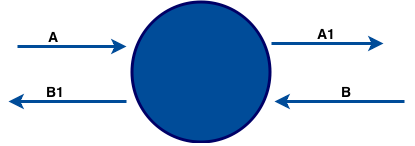
Let us suppose that the circle on the scheme is the planet Z. It is subjected to the influence of pressing beams A and B. If the planet Z remains immovable in relation to ASS, then the influence of beams A and B become equal in force. Because of it the absorption of beams A and B by the matter is the same. The beams A1 and B1, which are their continuations, are also equal in force. As it was noted above, the force of gravitation Fg is equal to the difference of pressing and repulsing forces. On that side of the planet, influenced by the beams A, the gravitation force Fg1 will be like the following:
Fg1 = A – B1
On the opposite side the force of gravitation Fg2 will be like following:
Fg2 = B – A1
In the case when the planet remains stationary , according to ASS, the difference of forces and gravitation will be like this:
(A-B1) = (B-A1)
Fg1 = Fg2
Now let us see the case in which the planet Z moves with the speed v in the direction of the interaction of beams B1, in the scheme from the right to the left. It means that in relation to beams A the planet moves with great speed. In such a case the friction between the beams A and the matter of the planet increases, the beams will be absorbed more intensively, and beams A1 will be much weaker. The situation connected with beams B1 will be different. In the process of movement friction between beams B and the matter of the planet will be much weaker, and beams B1 will be much stronger in comparison with the state of stationary ness of the planet. The relation of forces in the movement of forces will be like the following:
(A-B1) ‹ (B-A1)
Consequently:
Fg1 ‹ Fg2
It proceeds from all the said that the force of gravitation around the planet Z will change depending on the speed and direction of the movement of the planet. On the rear side of the planet the force of gravitation will be higher. And the higher is the speed, the stronger is the gravitation.
If the additional factor of gravitation emerges while the celestial bodies are moving, then for simplicity we shall call it gravitation of movement. The force of gravitation of movement will be equal to the difference of forces of gravitation when the celestial bodies are in the state of movement and stationary ness. It will be like the following:
F” = F1 – F2
Here F” is the force of gravitation of movement, F1 – force of gravitation in the process of movement, F2 – the force of gravitation in the state of stationary ness. Localization of maximal value of gravitation of movement will be along the line which crosses through the center of the planet and is the continuation in the opposite side of the vector of the movement of the planet.
The principle of dependence of the force of gravitation from the movement of celestial bodies is in conformity with certain natural phenomena. The orbits of the movement of planets around the sun, the orbit of the moon, and the orbits of satellite of other planets are elliptical in form. Had the forms of all the mentioned orbits been stable eternally, there would have not emerged other questions. But the orbits change. In addition, these changes take place not chaotically, but synchronically, in agreement with other phenomena. For instance, when the earth moves around the sun, direction of the major axis of orbital ellipsis of the earth changes significantly. These changes take place naturally and are repeated in certain periods of time. It is not difficult to imagine that a great force is needed to change the orbit of a huge planet. What is the source of such a great force? It is known that the very sun also moves in the space with great speed. This is not a linear, but a spiral movement in form. That is, the direction of the movement of the sun in the space constantly changes. If the direction of the movement changes, then the spatial localization of movement gravitation, which emerges behind the sun, also changes. In other words, the direction of the movement of the sun changes constantly and the source of maximal gravitation behind the sun changes, and the planets are obliged “to catch up” eternally this space by changing their orbits.
All the planets of the solar system are on the same plane, and this is explained differently. But it is inherent not only to the solar system. Dozens of billions of stars in spiral galaxies are also on one plane, in the disc of galaxy. In the universe there are billions of such galaxies. It means that the birth of the spiral form is not accidental, but natural. The galaxies also move in the space with a great speed. If there is movement, then there must emerge a sufficiently great gravitation movement around the super-massive black holes. The gravitation movement, on the one hand, the effect of gravitation summing, on the other hand, may gather a huge number of stars on one plane in the course of dozens of millions of years. It is necessary to take into consideration the fact that neither the solar system, nor the spiral galaxies are completely stable, ”stoned” structures. They are dynamic systems consisting of a great number intricately moving objects. Had there not existed the forces remaining on the same plane on one and the same plane, the entropy would have dissipated the stars of the disc in the whole halo.
Let us have a look at another “anomaly”, a physical phenomenon called “the pioneer effect”. Why do the cosmic vehicles change their orbits determined in advance? Up to the present day a satisfactory explanation for this enigma has not been found. It is highly probable that at a certain distance of their flights the vehicles flew through the space where the force of gravitation movement is maximal. This increase of gravitation, which has not been taken into account, led to an unexplainable acceleration of the speed of the vehicle.
A group of scientists have studied the birth and spread of explosions by using a super-new computer modeling method. They have come to such a conclusion that the explosion begins not directly in the center, but a little far from it. Logically, the explosion must take place in the point, where compression, pressure and temperature are the highest. When the celestial body moves, an effect of gravitation movement emerges. This effect emerges not only behind the celestial body, but also in the entrails of the very body. If to take into consideration that the increase of gravitation leads to much stronger compression, then the sphere of highest compression will be not in the center, but a little far from the center, in the opposite side of the movement vector. And the explosion takes place in that point.
At the beginning of this research there was such a question: why are all the celestial bodies of planetary size globular in form? After all the above-said it is possible to answer this question. The answer will be like this: only equivalent (almost equivalent) compression from all the sides may create and preserve globular forms of celestial bodies. But the celestial bodies are not alone in the space; alongside with them there are other planets, stars, black holes in the space. In addition to all this, celestial bodies with huge speed move in the space. Therefore compression by the gravitation beams from all the sides will not be ideally equal. Consequently, because of uneven compression the celestial bodies are not able to preserve ideally globular forms. The more is the difference between the compressions from different sides, the bigger will be the deformation of celestial bodies. It means that the form of celestial bodies will change constantly, if we proceed from the parameters of the movement in relation to ASS, and from the nature of interaction with other cosmic objects, the forms of celestial bodies will constantly change.
Friction among the parts of matter and gravitational beams give birth to a new question: why do not the celestial bodies cease their movement because of the constant friction? The answer to this question is connected with the very essence of gravitation beams. The beams are also moving with the speed of the light, and their final impact on the bodies depends on the vector summing impact of beams from all the sides. If the body is in stationary ness in relation to ASS, then the interaction from all the sides is equal in force. But when there is the factor of movement, compression from front and rear changes. Let us have look at it in the example of the movement of the planet Z.
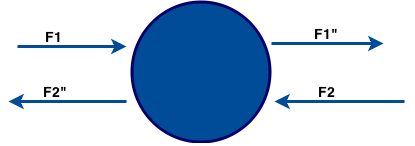
In case of stationary ness in relation to ASS, the beams F1 and F2 will be equal in force, it will be the same with F1” and F2”. In this case the pressure from all the sides is the same, they completely compensate each and the planet is in complete stationary ness. Now let us have a look when the planet is in motion. All the bodies, including the planet Z, consist of a great number of elementary particles. If the planet with a high speed moves in the direction of beams F2 (in the scheme it is from the right to the left), the friction between the particles located on the front part of the planet and beams F1 increases. Increase of friction exerts a braking impact on the particles in the front part of the planet. At the same time increase of friction leads to a great absorption of beams F1, and less number of beams F1” reach the particles in the rear of the planet. There emerges such a situation. In the rear of the planet the number of braking beams F1” decreases, but the number of pushing beams F2 does not increase. As a result of vector summing of the beams F2 and F1” the particles in the rear surface of the planet acquire an additional pushing force. That is, the braking effect to front parts is compensated by an additional pushing, which the particles in the rear part of the planet acquired, in this way the uniform movement of the planet is preserved.
The above-mentioned approach to the interaction of gravitation beams and particles of the matter allows explain the phenomenon of inertia. To explain this phenomenon let us appeal to the example of the planet Z once more. Let us suppose that it is necessary to increase the speed of the movement of the planet, which moves with the speed v. Increase of the speed leads to additional increase of the pushing force. Additional force is applied, the braking effect, which has emerged, is compensated and the speed of the planet increases. A new balance is created, and the uniform movement of the planet continues already with new parameters. Now let us suppose that it is necessary to decrease the movement of the planet Z. If a brake is applied, a surplus pushing force emerges. If to apply force, which will compensate this surplus, the speed decreases. The inertia phenomenon functions not only in changing the speed, but also in changing the direction of movement. It might be explained like this: When the direction of the movement changes, the process evolves new gravitation beams with a new complex of braking and pushing effects. For the compensation of the newly created effect it is necessary to apply corresponding force. If the force is applied, the direction will change. Movement is a vector quantity. It means that the wider is the angle of the change of direction, the higher will be the newly emerged effect and the required forces for their compensation.
Gravitation lensing and the changes connected
with it on the surface of the earth
If the force of gravitation depends on the movement in the space and character of the interaction with other celestial bodies, then the magnitude of gravitation lensing must also change because of the said factors. An experiment was made for the study of this dependence. A beams from the laser source is sent to the panel fastened to an immovable panel, which is at the distance of 160 meters. Two other control panels are placed between the last panel and the laser source. In the center of the control panels there are two holes with a diameter of 3 mm. And the sources of the laser and the final panel, which are 30 and 60 meters from the source, have been immovably fastened to the ground. The beam from laser passes through the two holes of control panels and fall on the panel, where a light circle emerges. As the light spreads straightly, the light circle on the panel must be in one and the same place. But it does not take place. The circle changes its place. This change of location takes place not chaotically, but only up and down, in exactly definite times of the day and with exact amplitude. In different days the amplitude of the movement differs from 3 to 10-12 mm. But there are also periods when there is no movement at all, or there is an insignificant movement. To exclude the probable influence of such local factors as temperature, humidity, pressure and others an experiment is conducted in two places simultaneously, the distance between these places is no less than 500 km. Despite the long distance and different weather conditions the light spots on both panels move identically. The logical explanation of these simultaneous movements of the light spots on the panels is that the force of gravitation on the earth changes, and it leads to the change of gravitation lensing. The experiment can be schemed like the following:
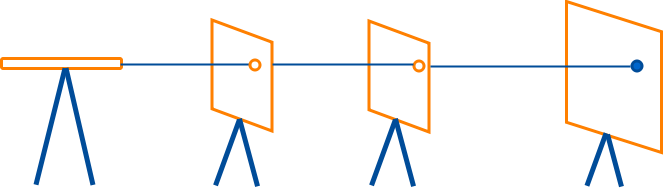
Movement of the earth in the space and its interaction with other celestial bodies are very complicated. Because of this movement the light circle on the panel is also sufficiently complicated. But among these complicated movements there are basic, much noticeable, synchronically reiterating daily movements. On day hours, beginning from 11-12 o’clock the light spot rises and reaches the highest position. Beginning from 18-19 o’clock the spot gradually drops down, and in night hours it remains in the lowest position. But in some weeks 3-4 hours successively at night time there is a short time rise ( 1-1, 5 hours) for 3-5 mm. Let us try to explain it with the help of the following scheme.

Let us suppose that the big curcle in the scheme is the sun, the small one is the earth. In the time of our experiment in day time the laser beam is subjected to the impact of the pressing beams A1 and repulsing beams C1. In day time a considerable part of beams A1 pass through the sun and weaken partially. Because of this weakening the laser beam inclines towards the weakened C1 beams, that is, towards the sun. As a result the light spot on the panel rises. The 3-5 mm rise of the light spot at night during some days may be explained by such a thing that this time beams A1 pass through other celestial bodies, for instance, through the earth.
Wave or particle
According to its nature light is a particle as well as a wave. Transformation of particles to waves and on the contrary (principle of indeterminite) can hardly be percieved from logical point of view. In order to understand the physical nature of the light a queue may be one of the enigmas of the quantum physics, namely, the experiment of interference of the single electron “with its ownself” when there atre two slits. As it is known, interference takes place when there are minimally two congerent waves. One of the variants of the birth congerent waves is the pass of one wave through two slits. Consequently, in the above-mentioned experiment the second slit creates the condition of congeretness. There arises such a question: Is the wave movement created by the very particles, or does something make the particles move like waves. If the single particle interferes only two slits, it means that congerentness is provided by the second slit, where there is no electron, but there is “something” which creates the congerentness. This “something” may be the wave environment, ( or a wave without without particles) created by the radiator. The logical inference from the above-said is like this: interference depends on congerent wave environment. Interfered ise not the particle, but the wavy environment together with the particles. In this case the number of particles is not decisive. Congerent wavy environment sends “the obidient” particles and places them on the interferential lines of the screen. In this case it is not important whether the particles pass through one by one, or in the form of big streams. The second paradox of the experiment with a single electron is the fact of the loss of interference when there is an observer. It may be explained by such a fact that the process of observation is an act of physical interference, which violates the congerentness of the wavy environment.
Let us try to look at the above-said in the example of light wave. In the source of light photons are generated. According to its type the light wave is diametrical. It means that the trajectory of the movement of photon in the space is not linear, but in the form of an S, or in the form of a zigzag. There emerges a question: If the beams are strictly straight, how can emerge a zigzag form trajectory of the photon? Let us try to find the answer with the help of the scheme below.
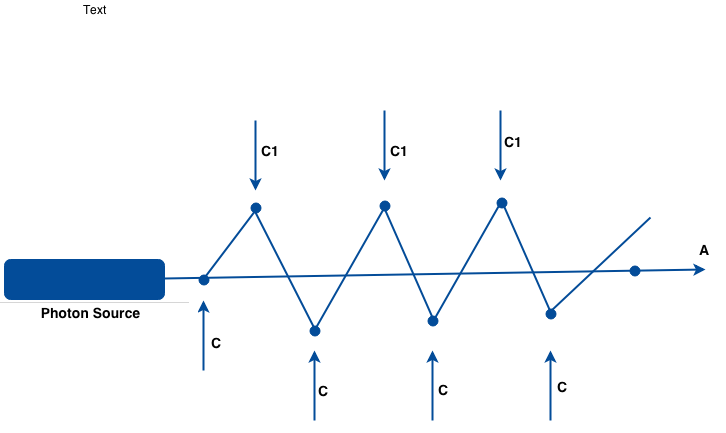
For the purpose of simplicity let us imagine that photons move under the influence of three types of beams. Beam A catches the photon when it leaves the source. The beams of the group C and the beams C1 exert influence on the photon horizontally from the sides. As soon as the photon begins its movement, it immediately falls under the impact of the beam C from the right. As a result of summing two perpendicular impacts of beams A and C, the photon moves forward on the diagonal to the left. This movement continues to such a point in the space, where the influence of beams C ceases. Here “the territory” of the influence of beams C1 begins at once. Then under the interaction of the beams A and C1 the photon moves forward on a diagonal to the right and so forth. The main carrier beam is A, the perpendicular interaction of the beams C and C1 in turn force the photon make wavy movement along the beam A. We must add that the next portion of photons may fall under the interaction of other perpendicular beams located, let us say, not horizontally, but vertically. Both photons move in the same direction, but under different angles of wavy vibration. That is, one of the photons will have horizontal wavy movement, the other – vertical wavy movement. In polarization only one of these photons will pass through the polarizator. All the above-said helps understand the essence of the dual nature of the light. According to the Theory of Beam Gravitation light is a stream of particles brought into a wavy movement by the gravitation beams.
These electromagnetic waves carry not only particles, but also spread electromagnetic waves. Let us suppose that passing through the active field of the generator, the beam areas are also charged. Let us think that the generator generates electric and magnetic fields in turn. Consequently, a part of the beams, which passes through the reaction field in the time of generation of electric field, become electrically charged. The part of the beam, which follows it, passes through the reaction field in the time of generation of the magnetic field, is enriched with magnetic charge. Perpendicular beams of C and C1 type force not the photons to make a wavy movement, but the electric and magnetic field around the carrier beams.
“Secret” of the red shift
As it is known, expansion of the universe is accompanied by the effect of the red shift. This is an astonishing phenomenon. When it takes place, the speed of the light remains, but the length of the wave grows. The Theory of Beam Gravitation explains that the prolongation of light waves is connected with the expansion of galaxy. The beams are stable with regard to ASS and move with the speed c. When the beaming object departs from us, it moves in the opposite direction in relation to those beams which takes the light to us from the object. To explain it let us once more appeal to the example of the river and the boat. Let us suppose that the river runs with the speed of 1m/s. But the boat moves with the speed of 0,2m/s against the stream. If the passenger of the boat throws into the river small light balls with the interval of a second, then the distance between the balls will be equal to 1m. In this case the speeds of the movement of all the balls down the river with regard to the bank will be 1m/s. If the light object moves with speed v,” with regard to the beam, then the beams pass through the body with speed c+v”. The frequency phase of radiation is the exceptional characteristics of the light object and it does not depend on the speed of its movement. Here in the example of galaxy, which is moving far from us, thee formula of measuring the length of the wave will be like the following:
λ = ( с + ѷ ) / Ѵ
Here λ is the length of the wave, Ѵ – frequency. Accordingly the length of the light wave from the approaching objects will be
λ = (с – ѷ) / Ѵ
In addition, the above-given formulas are correct in case if the observer does not move with regard to ASS. Red or blue shift will take place in the case when the observer moves with regard to ASS. In real conditions both the source and the observer move. In such a case the principle of summing speeds are preserved.
It proceeds from the said that the speed of light is absolutely constant only with regard to ASS. But all the objects in the galaxy move with regard to ASS. It means that the speed of the light for the observer will be equal to the sum of two speeds, the speed of light with regard to ASS and the speed of movement of the very observer with regard to ASS.
All what we see is a mirage
Existence of the star aberration is a fact. Owing to this phenomenon we see the stars not there where they are. But on the earth aberration is not observed, though the earth flies to the space with a huge speed, If in our daily life we had viewed distinctly the effect of aberration, seen all the things not there where they are in reality, but there where they were at the moment of reflection, (or emission) of light from them, then we had not been able to take the sight accurately, or conduct accurate construction work. But “not to see” the aberration does not mean that it does not exist. It exists, but the anatomic structure of the human eye surprisingly “smoothes away” the effect of aberration.
We see the world around us in three-dimensional format. We determine the location of objects along the line of the light beam from the pupil of the eye to the retina. Our eyes look along this line. But towards what have our eyes turned? We shall answer this question with the help of the scheme below:

Let us assume that at the moment of the emission of light the object is in the point A, but the retina of the human eye is on the level of point B. The object emits numerous beams to all sides. Let us have a look at two types of beams, beam a and beam b. If the earth had not moved in regard to ASS, then only perpendicular beam a would have reached our eye. Then our view would have been directed along the beam and we could have seen the object in the point A. But the earth moves. While the photons fly from the object to retina of the eye, the retina moves to the level of point B1, the side beam b falls on it, but beam b passes by. The light-sensitive cells are on the rear wall of the eye-pupil. It may seem that passing via the pupil the beam b falls on the left-side wall of the eye bottom. Had it been like that, we could have seen the object in the point A. But when the beam b passes through the pupil of the eye, the movement of the eye continues. At the moment of the fall of photons on the retina the pupil moves to the level of point B2, and the beam rests against the center of the bottom of the eye. In other words, in this moving system “pupil-bottom” the side beam b turns into perpendicular beam b1. As the direction of the look is determined along the line c, it sees the object in the point A1. Such a picture is achieved. Photons reach the eye emitted by the object in the point A, bur the person who looks at it, sees it in the point A1. We all see” the worn-out video” in the new place. But this is just a kind of mirage. If after the emission of the light the object disappears at once, we see it in the new place in the point A, though the object never occurs there. On the other hand, if we do not notice the aberration, it means that the object is there, where we see it. We all see” the worn-out video” of the object in the new place, while the very object occurs in the new place instantly. The mechanism of the birth of this strange effect may be explained like the following. While the photons of the side beam b in t time reach the retina, the eyes move to the level of point B2, the view is directed to the line and we see the object on the level of point A1. The eyes and the object move together with the earth. In the span of time t the eyes not only move from point B to point B, but the object also moves from point A to point A1. The movement of the earth in the space is uniform. Because of exceedingly less time t, this movement may be called linear. Under uniform-linear movement of the earth the distance from the point A to the point A1 will be equal to the distance from the point B to the point B2. In this case the beam line will be parallel to the line c. Consequently, the angle a (alpha) will be equal to the angle b (beta).Owing to equality of angles a and b we see the object where it is.
All the above said may be expressed in the form of the law below: In the frames of one uniform-linear movement system the effect of aberration is smoothened by the peculiarities of the three-dimensional vision. We must add that ‘the ghost” of the side beam does not allow confirm experimentally the effect of aberration in conditions of the earth.
© All Copyrights belong to Namiq Mammadov Bilal
______________________________________________________________________
Highlights of ICSCCW – 2015, Antalya, Turkey
I, Namiq Mammadov, participated at the scientific conference that was held in Antalya, Turkey under the guidance of Lotfi A. Zadeh. The conference took place on September 3rd and 4th, 2015. There I explained major points of Theory of Beam Gravitation. Rafiq Aliyev presented me at the conference and elaborated on what made this presentation possible. R. Aliyev mentioned that, when he and his friends read this theory and familiarized themselves with it, they decided that the research is quite interesting and needs more attention. Therefore, they decided to present this theory to other researchers and scientists who are more familiar with this topic. After the presentation, there were discussions and Q&A sessions.
Professor H. Roth from Germany asked:
Q: If the light is reflected on a mirror, then the gravitational beams that carry light photons are also reflected. Does this mean then gravity is also reflected or screened?
A: No. If the light photons can travel through Earth, then they can easily travel through a mirror as well. On the other hand, let me explain why light is reflected on a mirror. On the surface of a mirror, namely on the surface of every object that we see, the photons are “passed” from beams travelling in one direction to the beams travelling in the opposite direction. For this reason, the photons that are reflected from multiple mirrors continue to travel at the same speed, without losing any. If reflection was purely mechanical, then the photons would lose some speed just like a tennis ball that is bounced off a wall. The beams that carry towards the mirror and carry away from the mirror travel at the same speed. Therefore, the light photons do not lose any speed.
Russian Professor A.N. Averkin asked:
Q: The gravity model that you have created is a geometric model. There is a contradiction here. Lets assume that, Earth becomes smaller and smaller, turns into a black hole. The number of beams that can go through this small object becomes only one. Total of one beam will not be able to create a gravitational force as powerful as before. How is this contradiction explained?
A: First of all I would like to mention that, if Earth turned into a black hole, it would have a diameter of a few centimeters, which means that still a great number of beams can travel in that size of airspace. On the other hand, when Earth is planetary sized, significantly greater numbers of beams travel through. However, only a smaller amount of them are absorbed. If Earth became a black hole, then a smaller amount of beams would travel through, but all of them would be absorbed. Briefly, the number of absorbed beams stays the same. Even, hypothetically, if Earth became so small that only one beam could travel through; this does not mean that that this single beam creates the gravitational force. Beams are directed from all directions to all directions. Hence, n beams coming from all directions will also hit the point-sized Earth and get absorbed. The object attracted by Earth will preserve its original size, and the great number of beams that are directed at the same point will go through Earth and create beam gravity. In this case, the beams that are directed at the same point which go through the object, also the beams that pass through one point and dispersed over the object’s matter will create the beam gravity.
Azerbaijani professor T. Mammadov’s question:
Q: Can the experiments used during your research be utilized in some way to predict and study the catastrophic events (e.g. earthquakes) on Earth?
A: We did not encounter any catastrophic events during our experiments. Therefore, we do not know how such events, for instance, earthquakes would affect the results of the experiment. However, conducting the experiment in active seismic zones for an extended period of time can help us determine whether there is any correlation.
I would like to note it as well that, the conductor of the conference, Russian professor V.B. Tarasov found Theory of Beam Gravity quite interesting and called it a new direction in Physics. He also suggested usage of easier computer simulations to conduct new experiments and to better improve the results.

Professor and academic R. Aliyev and me.

Professor H. Roht, professor R.Aliyev and me.
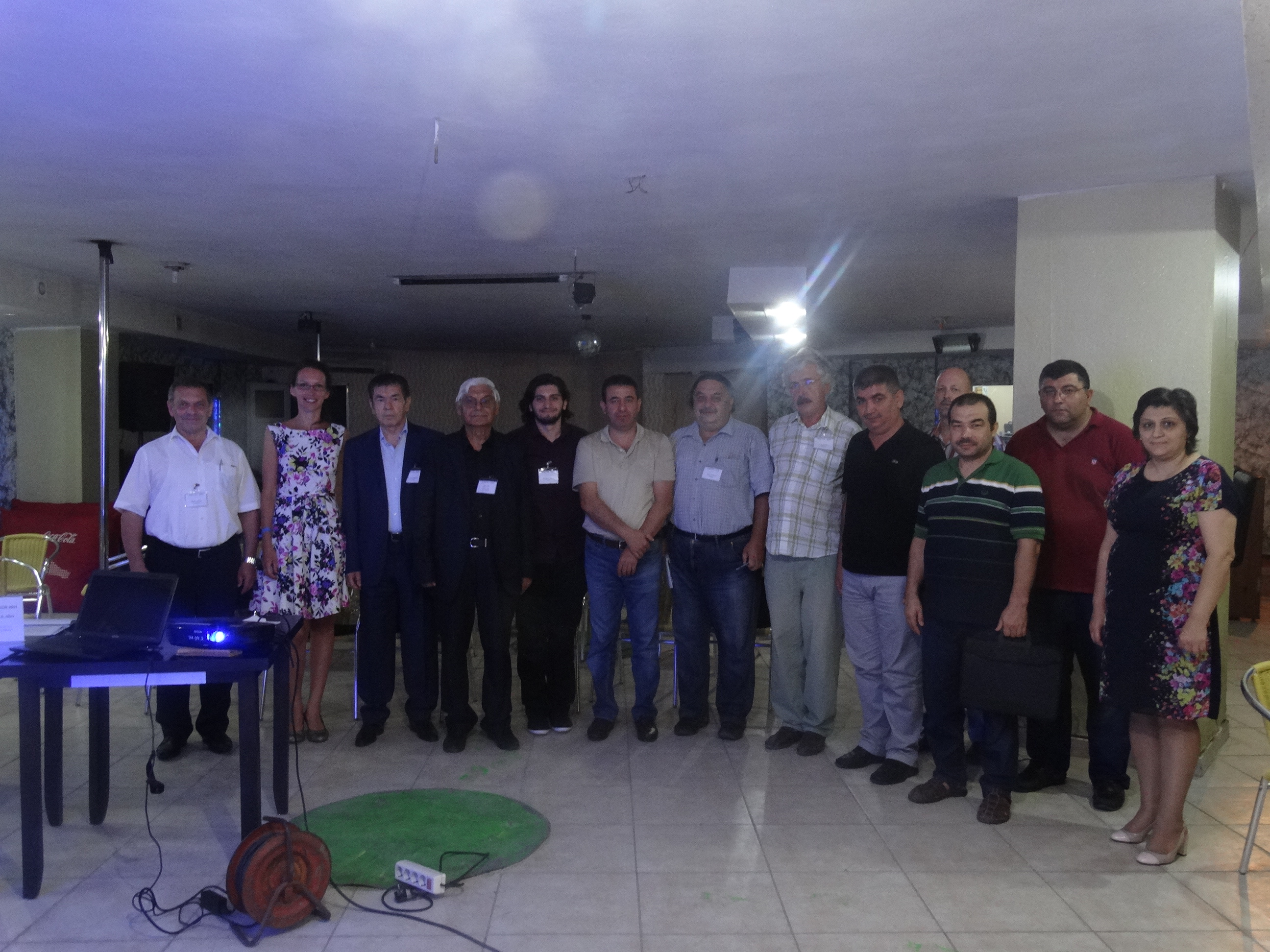
Professor R. Aliyev (Azerbaijan), professor N. Yusifbayov (Uzbekistan), professor V. Tarasov (Russia), professor H. Roht (Germany), professor A. Averkin (Russia), doctor M. Şahin (Turkey), professor Y. Degitaryov (Russia), In addition, other researchers and academics from Great Britain, Latvia, Azerbaijan, Northern Cyprus

 Beam Gravity Theory